After a challenging and enjoyable three years in Japan it is
time to say sayonara. While I’m sad to be leaving I am very happy to be going
home.
Showing posts with label Mount Fuji. Show all posts
Oshino river, flowing through Oshino village, is a spring creek approximately 2 kilometres in length. The water comes from springs around Mt Fuji and is considered a natural monument of Japan. Oshino is touted as the Mecca for Japanese fly-fishers and only 2 hours from central Tokyo. As the river is a spring creek the water is perfectly suited to salmonoids with Yamane, Iwana and rainbow trout but also a number of different fish species (Koi and char). One problem with the large number of fisher people and gin clear water is that the fish are very spooky and fly’s need to be very small and “match the hatch”. The highlight of the day was breaking the Yamane and Iwana duck and landing several of these beautiful fish (along with a nice rainbow).
On the day I visited, during the week, there were still a number of people and by mid afternoon it got a little busy to find a spot where you could fish uninterrupted (or not disturb others).
Yamame
Iwana
Iwana
Rainbow
Rainbow
About 30 minutes by train from Kamakura is Enoshima Island, a small island protruding into Sagami Bay. The main reason I visited the island was for the amazing views of Mt Fuji across the water, this the best time for these views (see my other post with pictures of Mt. Fuji from Enoshima Island).
Located on the highest point of the island, and offering spectacular 360 degree views of the coast line, Mt Fuji and the other side of the bay is the Enoshima observation lighthouse. For a small fee you can catch the elevator to the observation deck about 100 meters above the ocean and get great views of the surrounding area.
Linked to the mainland by a 600 metre long bridge the peak of the island is dominated by a shrine to Benzaiten, the goddess of music and entertainment. Benzaiten is said to have made the island rise from the bottom of the sea in sixth century and is apparently one of the three most famous goddesses in Japan.

Enoshima Island is also very popular with fisherman and on the day I visited they were everywhere trying their luck in a spectacular location.
On the back side of the island are two 6000 year old caves, the Enoshima Iwaya, made by the action of the waves. You can explore the cave if the weather is right with one cave containing religious artefacts, historical photographs and an automated fire-breathing dragon with guides handing out candles to visitor – just one thing – duck, the roof in places is very low.
You Tube video at http://www.youtube.com/watch?v=zyzQ3BmdLnY
Located on the highest point of the island, and offering spectacular 360 degree views of the coast line, Mt Fuji and the other side of the bay is the Enoshima observation lighthouse. For a small fee you can catch the elevator to the observation deck about 100 meters above the ocean and get great views of the surrounding area.

Enoshima Island is also very popular with fisherman and on the day I visited they were everywhere trying their luck in a spectacular location.
On the back side of the island are two 6000 year old caves, the Enoshima Iwaya, made by the action of the waves. You can explore the cave if the weather is right with one cave containing religious artefacts, historical photographs and an automated fire-breathing dragon with guides handing out candles to visitor – just one thing – duck, the roof in places is very low.
You Tube video at http://www.youtube.com/watch?v=zyzQ3BmdLnY
Following a recent visit to Enoshima Island I realised I had taken a huge number of photos of Mt. Fuji and couldn’t decide which ones to leave out.
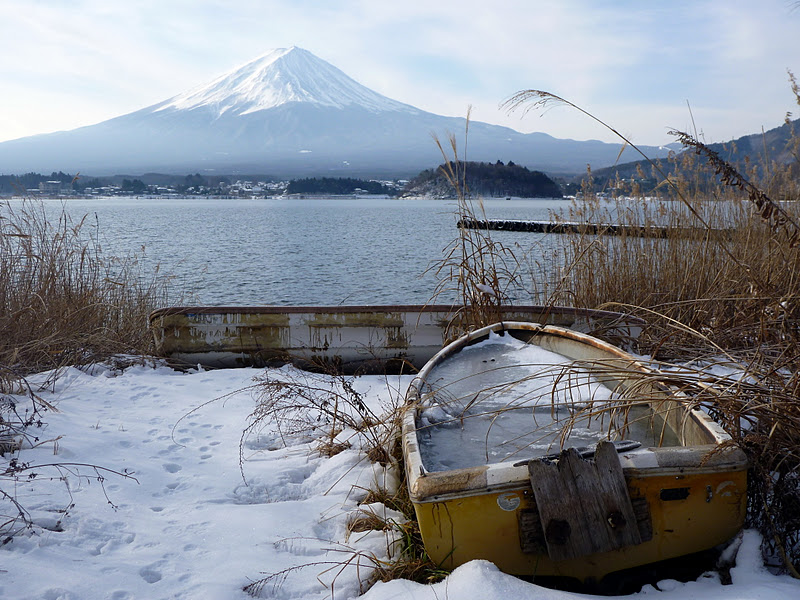
On the weekend I head to Kawaguchi (near the base of Mount Fuji) for a bit of a walk and to get away from Tokyo for a little while. The recent snow made for a wonderful sight in the mountains and the early morning reflections of Mount Fuji on Lake Kawaguchi were spectacular.
Driving out of Kawaguchi, stopped at traffic lights, there was this statue on the side of the road. Don’t ask me what it was for…
Driving across the bridge over the lake the car was jolted by a largish earthquake that had me feeling like the wheel had fallen off the car and looking to make sure I wasn’t going to drive into the lake. Shortly after arriving at the car park the car was again swayed by an earthquake and when I finally made it to the lake shore the boats started rattling in their cradles as another shake struck causing the lake bed to send bubbles up disturbing the surface of the lake. All very intense.
On this trip I took the cable car behind the town up to the mountain and was rewarded with great views of Lake Kawaguchi and Mount Fuji.
After winter arrived in Tokyo with such vengeance on Saturday with rain and wind making it feel like it was going to snow any moment then Sunday morning broke and the weather had changed 18o degrees. Bright sun and, when you found a place out of the wind, it was very pleasant to sit and drink a coffee.
On the way back across the rainbow bridge there was a wonderful view of Odaiba.
From Odaiba there are glimpses of Mt. Fuji across Tokyo bay and between the buildings near Tamachi station.
At one of the parks near Odaiba the Japanese maple were just starting to show their autumn colours – very spectacular.
Wow. I said that so many times as I watched the sun rise over Mount Fuji I lost count.
One of the things I had on my “must do” list when I came to Japan was to climb Mount Fuji and visiting Lake Kawaguchi a couple of weeks earlier only re-enforced this thought. Most people I spoke to prior to climbing the mountain suggested that the only time to climb was overnight because this allowed you to watch the sunrise from the summit of Mount Fuji. While some people elect to spend the night in climbing lodges up on the mountain and get up early to make the last little climb to the summit I decided to spend the night climbing.
Mount Fuji is officially open to tourists from the beginning of July to the end of August. Advice is that climbing Mount Fuji at any other time is dangerous because no lodges will be open (and the entire mountain is likely to be covered in snow and ice). “Open” means that the mountain lodges located on the ascent routes are open offering food, drinks and rest to those climbing the mountain along with a ¥200 charge to visit the toilets. The other thing you can buy if you really want are cans of oxygen. People who used the oxygen started early with people inhaling from the 6th station. One guy at the 8th station seemed to miss the point and was sucking down canned oxygen while holding a cigarette in the other hand.
The Yoshida, Subashiri, Gotemba and Fujinomiya trails are the 4 main trails to the summit of Mount Fuji. The research I did suggested that the Yoshida Trail is the most developed on Mount Fuji and best suited to what I had in mind. According to a website I visited the Yoshida trail has “modernised” facilities including lodges and some first-aid centres which ensure that climbing the mountain by this trail is “comfortable”. One of the warnings about the Yoshida trail was that because it is so popular there was a chance that it would be crowded and, if crowded, there is a risk that some people wouldn’t make it to the summit in time to witness the sunrise. An English map of the Yoshida trail can be found at http://www.mtfuji.jpn.org/fujimap_eng.pdf. The trail has 10 stations located at various heights with the 1st station being at the base of Mount Fuji and the 10th being at the top. With car access to the 5th station on most of the trails most people choose to start their climb at the 5th station on their chosen trail.
While the temperatures in Tokyo have been hot the temperatures at the top of Mount Fuji are winter like even in the midst of summer. I ended up wearing thermals, a down jacket (while sitting around waiting for the sun to come up), and windproof pants and jacket. Some people were wearing shorts, T-shirts and thin jumpers – there was a lot of shaking going on. Even more amazing were the number of people who didn’t have torches – yep that’s right – no torches. I can see the thought the process “…lets climb Mount Fuji at night time, do we need a torch? Nah, she’ll be right.”
I tried to time my visit to Mount Fuji to be towards the beginning of the climbing season to avoid the worst of the crowds that apparently start later in July and go through most of August. I watched Mount Fuji weather forecasts online for a couple of weeks prior to my trip (http://www.snow-forecast.com/resorts/Mount-Fuji/6day/top) trying to get a night where no overnight rain or clouds in the morning were forecast. With the weather site changing their forecast between the overnight and morning updates I decided at around 11 am that I should take the opportunity and head to the mountain after work. While the temperature in Tokyo was forecast to be around the mid 30’s the temperature at the top of Mount Fuji was forecast to be around 0 without considering the wind chill factor.
Leaving Tokyo the peaks to the west of the city were covered in cloud making for a spectacular sight as the sun went down.
After driving through the mountains I got my first sight of Mount Fuji from the road leading to the national park and it looked like the weather forecasts were going to be right.
The cost of entry to the Fuji national park is ¥2000 per car (cash only). After entering the park you begin the 18 kilometre drive up the side of the mountain to the Subaru line 5th station (the beginning of the Yoshida trail). The drive up the mountain is through forests and it was very pleasant to be able to drive with the windows down allowing fresh forest smells to fill the car. One distraction was, while wondering why a musical note had been painted on the road, crossing lines cut into the road and the tyres rolling up the road making music. Following the road as it wound up the side of Mount Fuji through the forests, watching deer at the side of the road, I soon emerged above the clouds. Above the clouds there was the first of many amazing sights of the trip.
The Subaru line 5th station is at an altitude of around 2300 metres above sea level and when I arrived the sun was just disappearing and lighting was playing in the clouds. I didn’t get a chance to look around in the dark (I took this photo the next day).
After quickly changing into some warm clothes and eating a cold pasta dinner I started the 6 hour trek up the mountain. The lower parts of the trail zigzag up the side of the mountain and are covered with loose, broken, volcanic rocks which was a bit like walking on sand. The second half of the trail was clambering up rocky “steps” through volcanic features.
There was an almost full moon and, until it disappeared behind the mountain and the terrain became more complex, it was pleasant to climb just in the moon light. About 1 am, at the 8th station, it started to get really cold with gloves and a beanie (tuque) needed. A thermometer on the side of one of the huts showed that the temperature was around 3 degrees with the wind whistling around the buildings making the temperature even lower.
Arriving at the top of Mount Fuji (3776 metres) around 3:00 am I was in for an hour and a half wait for the sun to begin rising. After putting on all of the clothes I had bought with me I settled in to wait watching the snaking line of ascending headlights rising up the trail below me. Around 4:15 am the sky began to lighten and then the sunrise began.
One of the things I had on my “must do” list when I came to Japan was to climb Mount Fuji and visiting Lake Kawaguchi a couple of weeks earlier only re-enforced this thought. Most people I spoke to prior to climbing the mountain suggested that the only time to climb was overnight because this allowed you to watch the sunrise from the summit of Mount Fuji. While some people elect to spend the night in climbing lodges up on the mountain and get up early to make the last little climb to the summit I decided to spend the night climbing.
Mount Fuji is officially open to tourists from the beginning of July to the end of August. Advice is that climbing Mount Fuji at any other time is dangerous because no lodges will be open (and the entire mountain is likely to be covered in snow and ice). “Open” means that the mountain lodges located on the ascent routes are open offering food, drinks and rest to those climbing the mountain along with a ¥200 charge to visit the toilets. The other thing you can buy if you really want are cans of oxygen. People who used the oxygen started early with people inhaling from the 6th station. One guy at the 8th station seemed to miss the point and was sucking down canned oxygen while holding a cigarette in the other hand.
The Yoshida, Subashiri, Gotemba and Fujinomiya trails are the 4 main trails to the summit of Mount Fuji. The research I did suggested that the Yoshida Trail is the most developed on Mount Fuji and best suited to what I had in mind. According to a website I visited the Yoshida trail has “modernised” facilities including lodges and some first-aid centres which ensure that climbing the mountain by this trail is “comfortable”. One of the warnings about the Yoshida trail was that because it is so popular there was a chance that it would be crowded and, if crowded, there is a risk that some people wouldn’t make it to the summit in time to witness the sunrise. An English map of the Yoshida trail can be found at http://www.mtfuji.jpn.org/fujimap_eng.pdf. The trail has 10 stations located at various heights with the 1st station being at the base of Mount Fuji and the 10th being at the top. With car access to the 5th station on most of the trails most people choose to start their climb at the 5th station on their chosen trail.
While the temperatures in Tokyo have been hot the temperatures at the top of Mount Fuji are winter like even in the midst of summer. I ended up wearing thermals, a down jacket (while sitting around waiting for the sun to come up), and windproof pants and jacket. Some people were wearing shorts, T-shirts and thin jumpers – there was a lot of shaking going on. Even more amazing were the number of people who didn’t have torches – yep that’s right – no torches. I can see the thought the process “…lets climb Mount Fuji at night time, do we need a torch? Nah, she’ll be right.”
I tried to time my visit to Mount Fuji to be towards the beginning of the climbing season to avoid the worst of the crowds that apparently start later in July and go through most of August. I watched Mount Fuji weather forecasts online for a couple of weeks prior to my trip (http://www.snow-forecast.com/resorts/Mount-Fuji/6day/top) trying to get a night where no overnight rain or clouds in the morning were forecast. With the weather site changing their forecast between the overnight and morning updates I decided at around 11 am that I should take the opportunity and head to the mountain after work. While the temperature in Tokyo was forecast to be around the mid 30’s the temperature at the top of Mount Fuji was forecast to be around 0 without considering the wind chill factor.
Leaving Tokyo the peaks to the west of the city were covered in cloud making for a spectacular sight as the sun went down.
After driving through the mountains I got my first sight of Mount Fuji from the road leading to the national park and it looked like the weather forecasts were going to be right.
The cost of entry to the Fuji national park is ¥2000 per car (cash only). After entering the park you begin the 18 kilometre drive up the side of the mountain to the Subaru line 5th station (the beginning of the Yoshida trail). The drive up the mountain is through forests and it was very pleasant to be able to drive with the windows down allowing fresh forest smells to fill the car. One distraction was, while wondering why a musical note had been painted on the road, crossing lines cut into the road and the tyres rolling up the road making music. Following the road as it wound up the side of Mount Fuji through the forests, watching deer at the side of the road, I soon emerged above the clouds. Above the clouds there was the first of many amazing sights of the trip.
The Subaru line 5th station is at an altitude of around 2300 metres above sea level and when I arrived the sun was just disappearing and lighting was playing in the clouds. I didn’t get a chance to look around in the dark (I took this photo the next day).
After quickly changing into some warm clothes and eating a cold pasta dinner I started the 6 hour trek up the mountain. The lower parts of the trail zigzag up the side of the mountain and are covered with loose, broken, volcanic rocks which was a bit like walking on sand. The second half of the trail was clambering up rocky “steps” through volcanic features.
There was an almost full moon and, until it disappeared behind the mountain and the terrain became more complex, it was pleasant to climb just in the moon light. About 1 am, at the 8th station, it started to get really cold with gloves and a beanie (tuque) needed. A thermometer on the side of one of the huts showed that the temperature was around 3 degrees with the wind whistling around the buildings making the temperature even lower.
Arriving at the top of Mount Fuji (3776 metres) around 3:00 am I was in for an hour and a half wait for the sun to begin rising. After putting on all of the clothes I had bought with me I settled in to wait watching the snaking line of ascending headlights rising up the trail below me. Around 4:15 am the sky began to lighten and then the sunrise began.
After spending most of the night climbing Mount Fuji I admit I was wondering just how good the sunrise would be – I needn’t have worried. Around 4:40 am the sun started to rise above the horizon. It was amazing, watching a full red orb appear over the horizon and rise up through the clouds. It quickly became apparent that I wasn’t the only one who was blown away by the sight with one guy in the crowd leading a 5 minute chant.
Following the sunrise I took about one hour to walk around the craters of Mount Fuji enjoying the warmth of the sun and views over the mountains and lakes surrounding Mount Fuji.
After walking around the craters I started the dusty two hour descent of the mountain via the descent track. Having missed the view the night before it was great to be able to take in the views on the way down.
Apparently there is a Japanese saying that goes something like “only a fool doesn’t climb Mount Fuji and only a fool climbs Mount Fuji more than once”. After having climbed the mountain I can agree with this sentiment – if people are able they should climb Fuji san, while I was very lucky with the weather the sunrise and view from the top of the mountain in the early morning sun was spectacular.
Following the sunrise I took about one hour to walk around the craters of Mount Fuji enjoying the warmth of the sun and views over the mountains and lakes surrounding Mount Fuji.
After walking around the craters I started the dusty two hour descent of the mountain via the descent track. Having missed the view the night before it was great to be able to take in the views on the way down.
Apparently there is a Japanese saying that goes something like “only a fool doesn’t climb Mount Fuji and only a fool climbs Mount Fuji more than once”. After having climbed the mountain I can agree with this sentiment – if people are able they should climb Fuji san, while I was very lucky with the weather the sunrise and view from the top of the mountain in the early morning sun was spectacular.
.jpg)