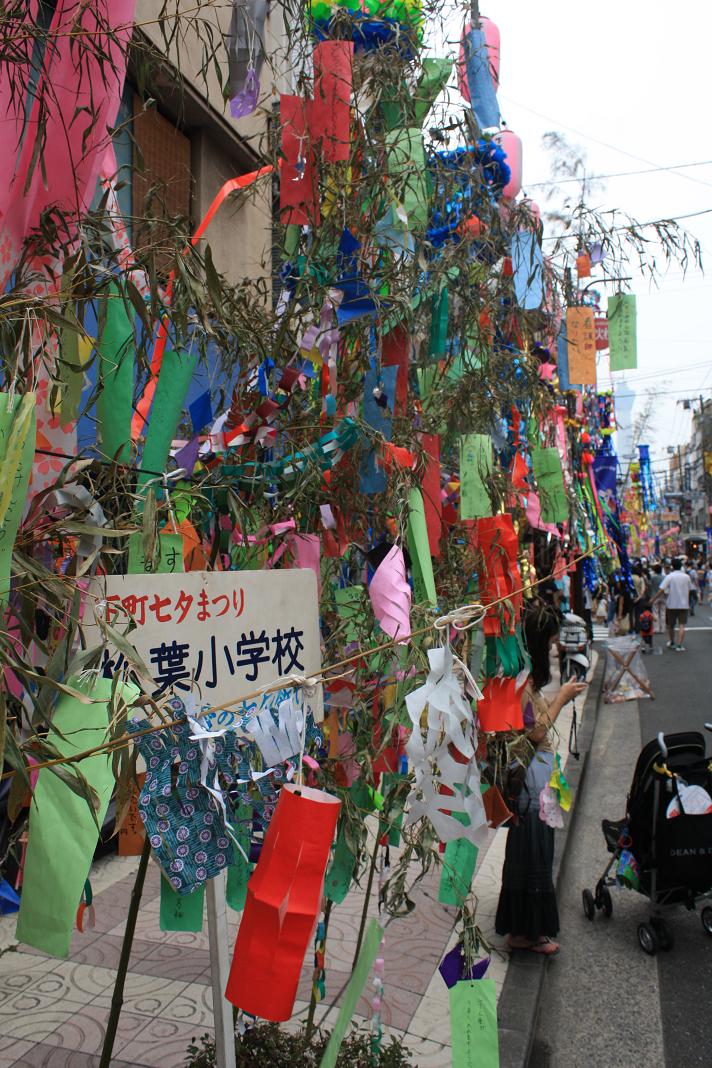
Festival season really picks up in July and August and we managed to come across the very visually spectacular festival “tanabata” last week. Tanabata literally means the night of the seventh, and it's also known as the star festival. Tanabata is supposed to take place on the seventh day of the seventh month but this festival had been running for a week and showed no sign of slowing down. The streets were decorated with great big streamers and paper balls. In this area one whole street, about two kilometres long, was lined with these streamers. Spectacular.
People also take the opportunity of tanabata to write their wishes on paper and hang them on bamboo branches. They also make any number of paper decorations and hang them up outside their houses and shops. Some of the folded papers were very intricate.
While a traditional festival there is still room for others to join in and on one of the side streets there was a line of Harleys ready to roar down the street (after the marching girls). Some of the decoration and time that has obviously gone into these machines is staggering.
10:17 AM |
Category:
festivals,
Living in Japan
|
On a recent Sunday visit to the Tokyo Dome area I came across a truely bizarre sight.
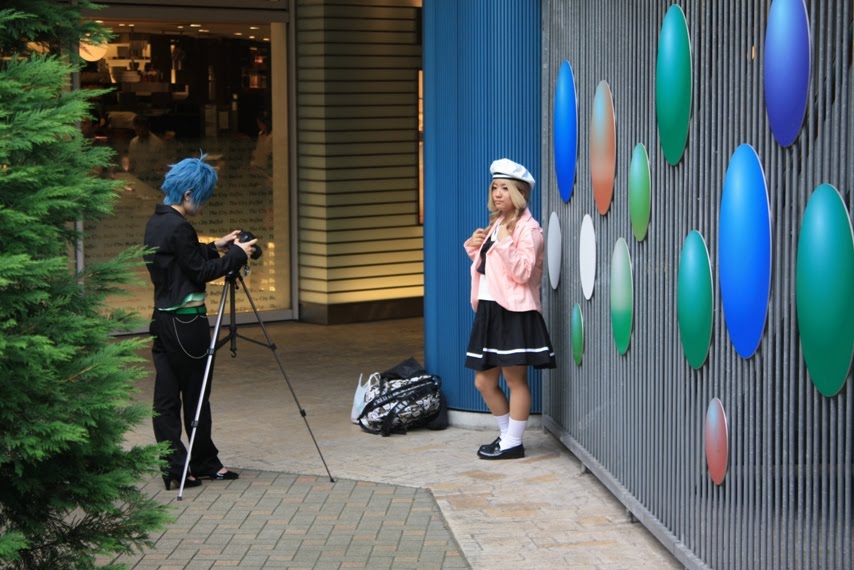
Japan is well know as the home of Cosplay and while I had seen random examples of people dressed as their favourite characters (or just any character) around Tokyo the concentration in the area of the Tokyo Dome on this day was amazing. There were nurses, characters from cartoons, obvious old school Australian one day cricket fans and all manner of school girls and warriors. The most bizarre costume was the woman dresses in a full body leather suit wearing a motorcycle helmet styled to look like a cats head (it was 30 degrees celcius and 90 percent humdity) - no photos of that - sorry.
It is cherry season here in Japan and I was lucky enough to travel to one of the areas where Japanese cherries are grown. Japanese cherries are white fleshed cherries and taste amazing. An indication as to the effort that goes into producing these cherries is highlighted by one of the orchards I passed that had an oil fired heater to ensure that the temperature in the hot house was constant early in the season.
The orchard I visited was completely enclosed to keep the animals out and the ground under the trees had reflective tarps to focus the heat on the cherries. As you can see the end result looked amazing. Even more amazing was the fact that the farmer ensured some of his cherries were sampled straight from the trees.
After seeing, and tasting, all those cherries on the trees I was compelled to buy some to take home. Being Japan, and being a specialised fruit, they were not cheap. A one kilogram box of the top grade cherries was 6000 yen (about 75 Aussie dollars).
When you open up the box there are two hand packed 500 gram punnets. The taste is as good as they look and while the cherries are expensive, when considered a special treat, they are worth almost every cent (no they are not polished).
In preparation for getting a car I had to go and get a Japanese license. I was warned that it was likely to be a long process and that I would need half a day to complete the process. Luckily I was warned.
When you first arrive at the window on the second floor they give you a number, time to take a seat and wait. Twenty minutes later I was called up and they gave me a piece of paper to sign and then looked through all of the documents you are required to bring with you and then it time to take a seat and wait, again. Forty minutes later they called me up and sent me off for an eye sight test on the first floor. Another queue and having to then wipe the sweat off the forehead rest of the machine from the guy before me was a real highlight. You have to look through the eye pieces and identify gaps in circles and colours??? You have to take the results back up to the second floor and then its time to take a seat and wait, again. Forty minutes later I was called up to get my papers again and this time its time to go and queue and get your photo taken on the first floor. After having my photo taken it was time to head for a different room, this time the 3rd floor. It was like sitting in a bingo hall waiting except your waiting for your license number to be called on the electronic boards. Forty minutes later, bingo, Japanese license. Time to get out of there and start looking for a car.

3:02 PM |
Category:
Living in Japan
|
I decided to try, again, to find Kappabashi and this time I managed not to get lost and have a little look around. This street has eight blocks of any sort of kitchenware that anyone could want including knives, bowls, plates, cooking equipment, shop fittings, uniforms, signs, etc. Basically anything you need to establish or maintain a restaurant you can find in this street. To give some hint there is a shop called “Kitchen world”.
The main reason I wanted to find this area was to look at the plastic food shops. This area is supposed to be the home of the plastic food replica. A lot of restaurants and cafes in Japan have plastic replicas of the food they serve in their restaurants out in display cases on the street to entice you in. There was the mandatory sushi represented in the model but also beer, fruit and deserts. Some of the deserts looked almost good enough to eat.
5:09 PM |
Category:
Out and about
|